
Networking as a Service (NaaS)


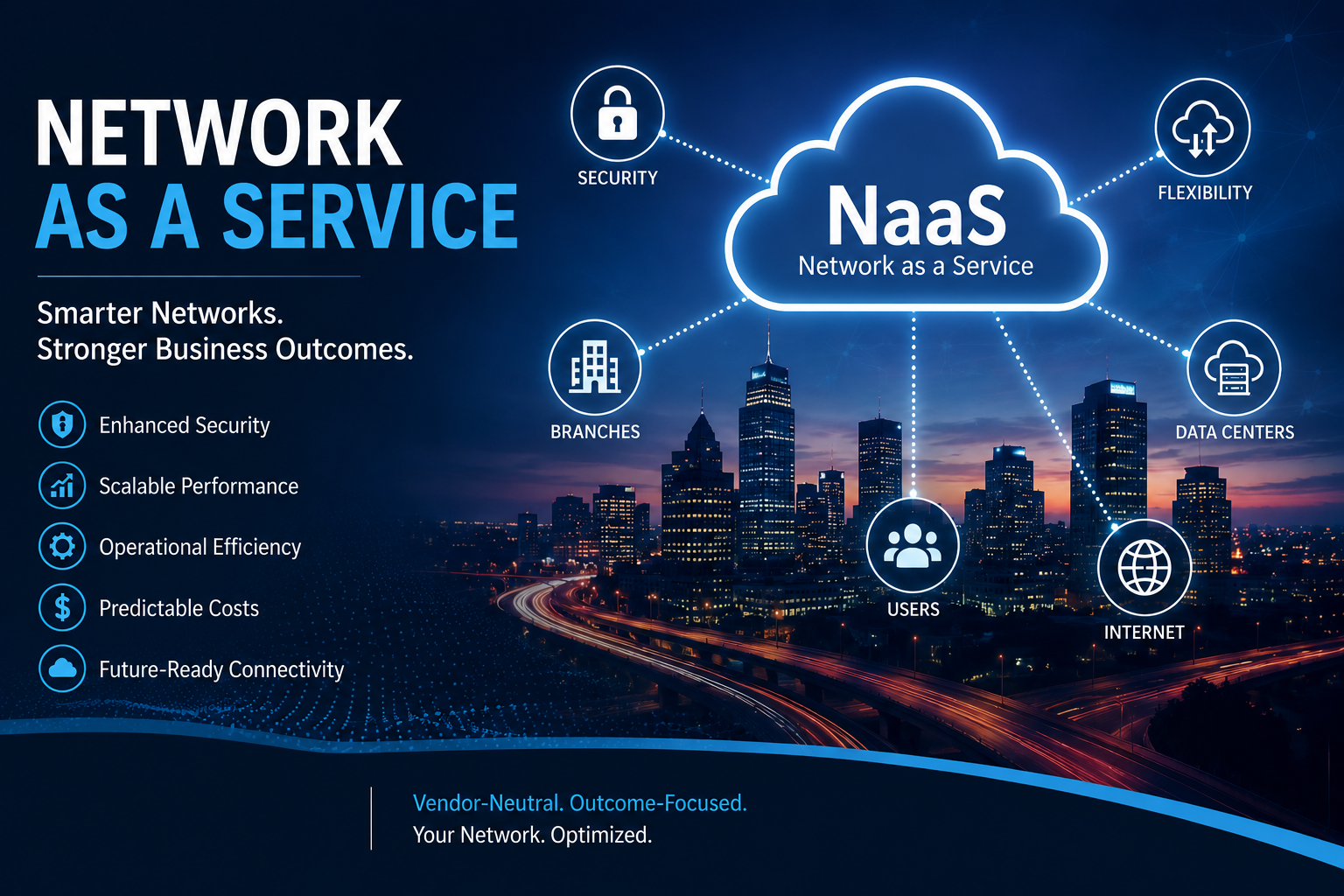
Network as a Service (NaaS): Why Businesses Are Rethinking Their Networks
Traditional business networks were built for a different era.
Back then, most employees worked from a central office, applications lived inside a company data center, and bandwidth demands were relatively predictable. Today, businesses operate across cloud platforms, remote offices, mobile users, SaaS applications, AI workloads, and increasingly complex cybersecurity requirements.
The result? Many organizations are trying to support modern business operations with networking infrastructure that was never designed for the way companies work now.
That is why Network as a Service (NaaS) has quickly become one of the fastest-growing models in enterprise technology.
According to industry analysts, organizations are accelerating investment in flexible, cloud-based networking strategies as businesses demand greater agility, simplified operations, stronger security, and predictable costs. Gartner and other industry research firms continue to highlight the growing shift toward consumption-based IT models and cloud-managed infrastructure.
The reality is simple: businesses no longer want networking to be a constant operational burden.
They want performance.
They want visibility.
They want security.
And they want flexibility without having to continuously replace hardware every few years.
That is where NaaS changes the conversation.
What Is Network as a Service (NaaS)?
Network as a Service is a cloud-based consumption model that allows organizations to acquire and manage networking capabilities as an ongoing service instead of purchasing, maintaining, and refreshing all networking infrastructure internally.
Rather than making large capital investments in switches, firewalls, wireless infrastructure, SD-WAN appliances, and carrier circuits, businesses consume networking services through a subscription or operational expense model.
Depending on the solution, NaaS may include:
- Wired and wireless networking
- SD-WAN
- Managed Wi-Fi
- Cloud connectivity
- Security services
- Network monitoring
- Performance analytics
- Zero Trust networking
- Internet aggregation
- Lifecycle management
- Hardware refreshes
- 24×7 support and management
In practical terms, NaaS allows organizations to shift away from managing infrastructure and focus more on business outcomes.
Why Businesses Are Moving Toward NaaS
1. The Network Has Become More Complex
Modern IT environments are no longer centralized. Applications now live across:
- Public cloud providers
- Private cloud environments
- SaaS platforms
- Remote locations
- Hybrid work environments
- Edge computing deployments
At the same time, organizations are dealing with growing cybersecurity pressures, AI-driven traffic demands, compliance requirements, and increasing user expectations.
Managing all of this internally can strain both IT teams and budgets.
NaaS helps simplify operations by consolidating networking, visibility, management, and support into a unified service model.
2. Capital Expenses Continue to Rise
Traditional networking requires significant upfront investment. Most organizations face recurring refresh cycles involving:
- Firewalls
- Switches
- Wireless access points
- SD-WAN appliances
- Licensing renewals
- Support contracts
Those costs often arrive all at once.
NaaS shifts networking into a predictable operational expense model that aligns more closely with how businesses consume cloud services today. For many organizations, this creates:
- Better budgeting predictability
- Lower upfront costs
- Easier scalability
- Reduced lifecycle management burdens
3. Internal IT Teams Are Overloaded
Many IT departments are already stretched thin. Internal teams are expected to manage:
- Cybersecurity
- Cloud migration
- AI initiatives
- Compliance
- End-user support
- Infrastructure modernization
- Business continuity planning
Networking management often becomes reactive instead of strategic.
NaaS enables businesses to offload day-to-day network operations while still maintaining visibility and control.
4. Businesses Need More Agility
Traditional networking models can slow down growth. Opening a new office, upgrading bandwidth, deploying secure Wi-Fi, or supporting remote users often requires:
- Multiple vendors
- Long procurement cycles
- Hardware lead times
- Complex implementations
NaaS solutions are designed to scale more quickly and adapt as business requirements change.
That flexibility has become increasingly important for organizations navigating mergers, acquisitions, hybrid work strategies, AI adoption, and digital transformation initiatives.
The Financial Case for NaaS
One of the biggest misconceptions about NaaS is that it is only about outsourcing networking. It is not. The real value is operational efficiency. Businesses frequently discover hidden costs in their networking environments, including:
- Underutilized circuits
- Duplicate providers
- Outdated contracts
- Oversized bandwidth
- Unsupported hardware
- Expensive maintenance agreements
- Lack of carrier accountability
At Complete Communications, we regularly help organizations uncover unnecessary technology spend while improving network performance and reliability.
Because we operate as a vendor-neutral technology advisor, our role is not to push a single carrier or manufacturer. Our responsibility is to help clients identify the right solution for their business requirements, operational goals, and budget.
That distinction matters.
Too many businesses are still receiving networking recommendations from organizations financially motivated to sell one specific platform.
Security Is Now a Networking Conversation
Networking and cybersecurity are no longer separate discussions. Modern NaaS platforms increasingly integrate:
- Zero Trust architecture
- Secure access controls
- SASE frameworks
- Network segmentation
- Threat visibility
- Continuous monitoring
- Identity-based policies
As cyber threats continue to evolve, businesses are realizing that security must be embedded directly into the network architecture itself. This is especially important for organizations with:
- Remote workforces
- Multiple office locations
- Cloud-first environments
- Compliance requirements
- Customer data responsibilities
Industry analysts continue to emphasize the growing convergence of networking and security as organizations modernize infrastructure strategies.
Where NaaS Delivers the Most Value
While nearly every organization depends on reliable connectivity, NaaS tends to deliver particularly strong value in environments with:
1. Multi-Location Businesses
Organizations with multiple offices often struggle with inconsistent providers, fragmented support, and limited visibility. NaaS creates centralized management and standardization across locations.
2. Rapidly Growing Companies
Businesses experiencing growth often need scalable infrastructure without large upfront capital investments.
3. Hybrid Work Environments
Supporting remote users securely and consistently has become a long-term operational requirement.
4. Organizations With Lean IT Teams
Many mid-market businesses simply do not have the internal staff to manage increasingly complex networking environments.
5. Businesses Pursuing AI and Cloud Initiatives
AI workloads, cloud applications, and real-time collaboration tools place increasing demands on network performance and reliability.
Why Vendor-Neutral Guidance Matters
The NaaS market is evolving rapidly. There are now dozens of providers offering various versions of:
- Managed networking
- SD-WAN
- SASE
- Cloud connectivity
- Managed Wi-Fi
- Secure access solutions
- Internet aggregation
Not all solutions are designed the same.
Some are carrier-centric.
Some are hardware-centric.
Some prioritize cloud networking.
Others focus heavily on security integration.
That is why businesses benefit from working with an independent technology advisor instead of navigating the market alone.
At Complete Communications, our mission is to serve as a lifelong technology advisor by managing the full lifecycle of technology services, from provider selection through contract renegotiation. We help organizations:
- Evaluate current network environments
- Identify operational gaps
- Compare providers objectively
- Negotiate contracts
- Manage implementations
- Improve visibility and accountability
- Align networking with long-term business goals
Most importantly, we remain vendor agnostic.
That means our recommendations are based on what is best for the client, not what generates the highest commission from a specific provider
The Future of Networking
The shift toward NaaS reflects a broader transformation happening across enterprise technology. Businesses increasingly expect infrastructure to behave more like cloud services:
- Flexible
- Scalable
- Consumption-based
- Secure
- Easier to manage
- Faster to deploy
Networking is no exception. Organizations that continue operating with fragmented legacy infrastructure may find themselves facing:
- Rising operational costs
- Limited visibility
- Increased cybersecurity exposure
- Slower scalability
- Reduced business agility
NaaS is not simply a networking trend.
For many organizations, it is becoming the operational model that aligns networking with how modern businesses actually operate.
Final Thoughts
Your network impacts nearly every part of your business.
If connectivity is unreliable, security is inconsistent, visibility is limited, or costs continue to rise, those issues eventually affect employee productivity, customer experience, and overall business performance.
Network as a Service gives organizations a more flexible and strategic approach to networking, without the burden of constantly managing infrastructure internally.
The key is choosing the right strategy, the right providers, and the right long-term partner.
Ready to Evaluate Your Network Strategy?
At Complete Communications, we help organizations simplify technology decisions through independent, vendor-neutral guidance. Whether you are evaluating:
- NaaS
- SD-WAN
- Managed Wi-Fi
- Cloud connectivity
- Internet aggregation
- Cybersecurity integration
- Carrier consolidation
- AI-ready infrastructure
Our team helps you identify, select, negotiate, implement, and manage the right technology solutions for your business.
Schedule a Technology Assessment
If you would like an independent review of your current networking environment, contact Complete Communications to schedule a technology assessment and discover whether a NaaS strategy makes sense for your organization.
- Call us at: (407) 512-5086
- Schedule a consultation: https://calendly.com/rob_completecomm/30min
- Email us at: info@completecomm.com


Newsletter
Newsletter
Need Help?
Our technology experts are here to help. Whether you’re evaluating cloud solutions, upgrading your communications infrastructure, or planning a complete digital transformation, Complete Communications provides the guidance you need to make informed decisions.
Get expert consultation on everything from VoIP business phone systems and network connectivity to AI automation and cybersecurity solutions. We’ll help you identify the right technology mix for your specific business requirements and budget.
Ready to get started? Contact us today for a free consultation and discover how we can simplify your technology while fueling your business growth.